


The second session of the Dignity by Design global course honed in on the building ecosystem.
There are multiple decision-makers throughout the building lifecycle making multiple decisions. And some have (much) more power and influence than others. We explored how those decisions can be made in ways that avoid harm to people, and maximize positive outcomes.
I shared this “leverage” map of the ecosystem.
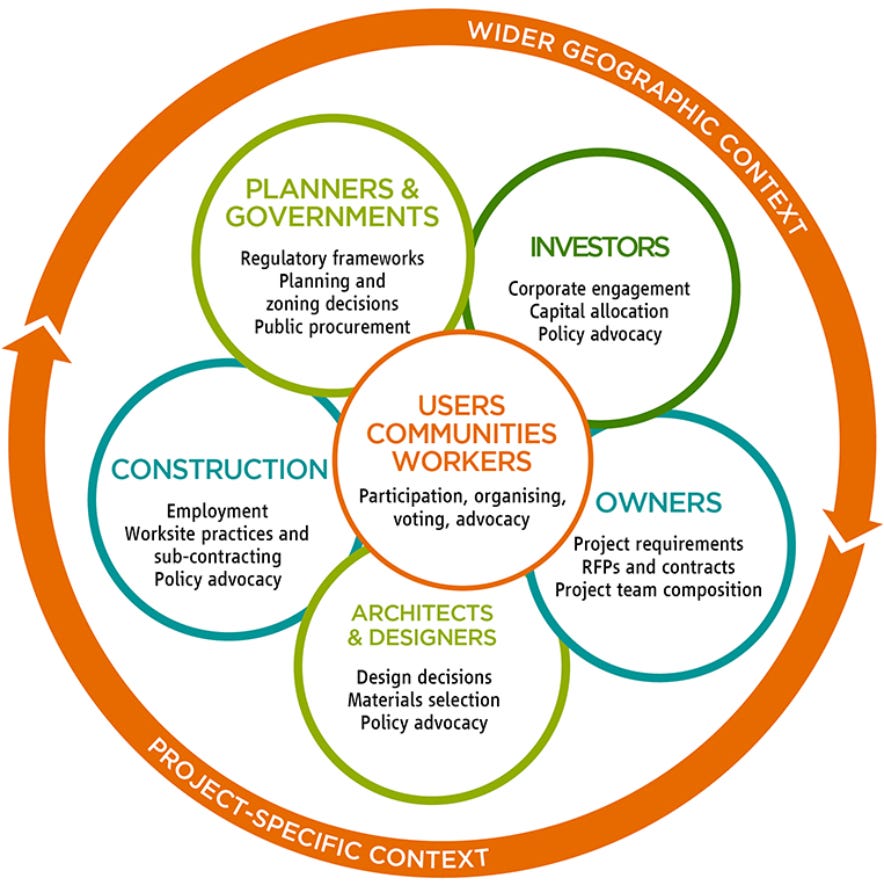
No actor can transform outcomes alone but everyone has specific roles they can play - in the wider policy and finance landscape and/or in the context of individual built projects.
For example, investors’ influence comes first and foremost from what they invest in (and across what timeframes), i.e. capital allocation. They can hone in on systemic risks at their portfolio level (ideally!) and engage individual companies that they invest in.
Project owners, whether public or private, have a key role setting the project vision and requirements from the outset, and embedding social and environmental dimensions into procurement.
And whatever the leverage point being harnessed, social outcomes have three dimensions:
mitigating risk and avoiding harm
expanding social opportunity
and having effective grievance mechanisms in place for when harm does occur
The two guest faculty were from the World Bank (which finances infrastructure projects, with between USD $80-100 billion assets under management), and Aberdeen Asset Management’s real estate division (with around $48 billion AUM).
Both have significant influence over which projects move forwards in the first place and then how those projects move forward, for example in the World Bank’s case through its consultation and performance standards, and in Aberdeen’s, through its recently-developed blueprint for social value. Both also face limitations to using their leverage for better social outcomes, from closed or repressive governments, to the primacy of short-term financial returns.
Exploring leverage points across the built environment ecosystem takes more than a 90 minute class. But what I like about this session is the possibility of unpacking to reimagine, of revealing roles and relationships to dig into how they are currently harnessed and how they can be harnessed differently.