


Where does the “real” and “imaginary” collide more than in a theater?
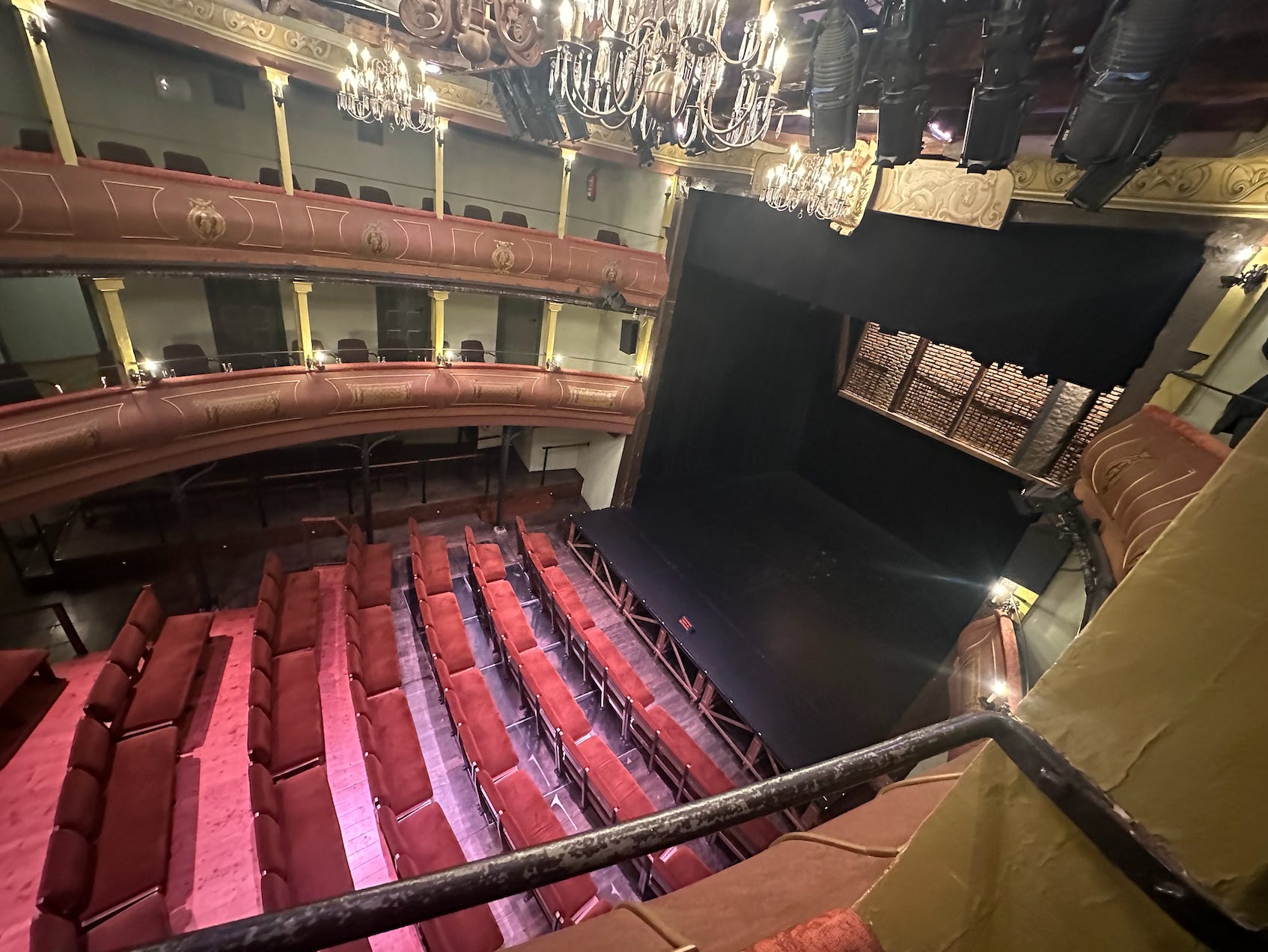
A highlight of 2025 was a short tour of the Corral de Comedias in Alcalá de Henares, a city to the northeast of Madrid. The theater first opened in 1602, as a patio tucked between houses alongside the city’s main plaza. (At the time the plaza was called Plaza del Mercado. Later it was renamed Plaza de Cervantes, as Alcalá is where the author of Don Quixote was born).
I say tour, but this was different, a simple and immersive monologue by the guide, who transported us back with her words and gestures through the stages of the theater’s life. At first, the plays were religious. They communicated stories written in Latin to an audience that didn’t speak Latin. Resident animals from the patio were shooed to the side before performances.
The theater evolved into a place for entertainment. Hundreds crammed in to watch long plays - calling out for lines to be repeated if they hadn’t caught them over the din of the audience. Female spectators stood in a cordoned-off area at the back, fanning themselves in the heat and using their fans to communicate with suitors in other parts of the theater, giving rise to the “lenguaje del abanico”, fan language.
The theater established connections with the court in Madrid, linkages that meant it kept going when the majority of other Corrales (courtyard theaters) were shut down for their unsanitary conditions. It was given a more solid structure, with a network of beams supporting a domed roof.
Eventually though it entered a period of decline, as people found other forms of entertainment. It became a cinema for a while, then students at Alcalá University researched its origins, took a look behind the movie screen and discovered the structure of the theater still largely intact, leading to its renovation and re-opening in the 2000s, done carefully and thoughtfully so that when you walk down under the stage you can still see the original patio from the 1600s.
During her tour, the guide showed us technological innovations that were used in productions back in the day. A kind of spinning barrel that makes a sound just like the wind. Another contraption that makes the sound of thunder. A platform beneath a stage trapdoor that enabled actors to magically appear, or disappear. Creative artifice.
We returned to the theater for that evening’s performance. (We had booked late, so were seated to one side, meaning that my view was partially obscured by a beam which at first annoyed me until I realized that was just right, a reminder of the structure that was holding us together to share this slice of time, just as it had many audiences past).
The play happened to also be a monologue, a performance of El maestro Juan Martínez que estaba allí (The master Juan Martínez, who was there). It’s based on the journalistic account of the life of a flamenco dancer and teacher traveling through Istanbul, Romania and then Russia, just as the Russian revolution broke out in 1917.
As the play draws to a close, Martínez looks out from the Odessa docks to a boat that is likely taking him back to Europe, after six years of chaos and hardship. Suddenly he feels frozen to the spot. What will “home” be like, and will people remember him? Which is real, he wonders, the life in Russia he is leaving behind or the one he is about to return to?
Martínez’ confusion echoes that of Segismundo, a character in La Vida es Sueño by Calderón de la Barca, whose plays were also performed at the Corral in Alcalá.
“¿Qué es la vida? Un frenesí.
¿Qué es la vida? Una ilusión,
una sombra, una ficción,
y el mayor bien es pequeño;
que toda la vida es sueño,
y los sueños, sueños son.”
***
“What is life? A frenzy.
What is life? An illusion,
A shadow, a fiction,
And the greatest good is small
As all of life is a dream,
And dreams, are but dreams.”
I was mind-blown by the way that words written at a point in time travel across years, centuries, to convey stories and experiences to people in the future.
I keep coming back to that experience in the theater, as something essential. Something profoundly human, and perhaps reassuringly so, as accelerated technology encompasses language itself and makes the distinction between real and unreal more blurred than ever. If we remember that this blurriness has always been a part of existence it can become less disorienting. We can lean into it with all the curiosity and wonder, creativity and playfulness that make us human in the first place. We can keep hold of the agency to choose what to believe, and what to question.