


Buildings & Cities Journal (always a source of inspiration!) has published the results of its “Why it Matters” video contest.
The contest challenged PhD students around the world to create a two minute video aimed at the general public. The video should explain “clearly, succinctly and creatively why your research matters and how it fits into the wider context and might contribute to society.”
It’s no small feat to boil the substance of a PhD down into a two minute video. And yet it’s such an important exercise in communicating complex research in a way that can resonate widely, and change mindsets and action.
The winning video is by Zekun Li at Carnegie Mellon University in the US.
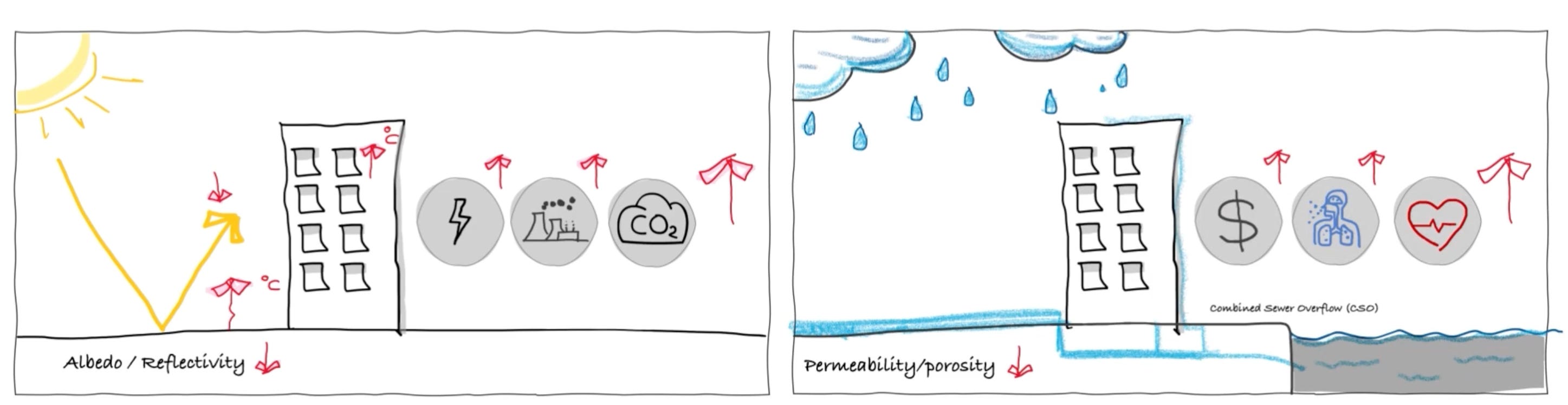
Her video calls for a new approach to city surfaces. Seventy percent of the surfaces in US cities are both paved, and dark. This has the double-whammy effect of contributing to flooding AND to extreme heat, but those two dimensions are rarely tackled together. The social implications are increasing heat-related deaths and the soaring costs of flooding damage.
Two obstacles stand in the way of progress: government agency silos, and the fact that decisions are usually, as Zekun Li puts it, “economically driven, ignoring the long-term benefits of health improvements and social equity”. Here, yet again, the long-term costs of short-term economic thinking are abundantly apparent.
Her research has created a taxonomy of 50 surface materials, categorizing them by their temperature, rainwater retention and carbon reduction properties, with the aim of guiding decisions towards more beneficial options.
City surfaces are a clear example of materials having a material impact on people and the planet, and of a narrow focus on financial materiality overlooking wider and longer-term costs.
Among the “excellent video” category winners is the short video by Sarath KT of the Indian Institute of Technology Bombay and Elements Creative, on public transport in Mumbai.
Public transport is a “lifeline to opportunities”, particularly for residents of informal settlements. Yet Sarath’s research found inequity in three areas: the spatial distribution of transport services; budget allocation; and inclusion of vulnerable groups in planning processes and decisions. And despite the transformative role of public transport, current policies “favor private vehicles, with huge investments towards motorways”.
Watch the video, “Equitable Transport in Emerging Economies”, here:
And access all the winning videos and a gallery of other entrants here.
*****************************
Through 2024, It’s Material is sharing one use of the word “material” each week, on Tuesdays