



This morning I joined a FORGE (Future of Rights and Governance) “ideas and action” session with Zahra Ebrahim of Monumental. Her new article “Expanding beyond the human in public engagement” was the session’s jumping-off point.
There was food for thought to last a long time: without doing the full session justice, here are some elements that came up and reflections it prompted.
On public consultation
Public consultation on urban development so often comes with multi-layered constraints that dramatically limit its outcomes. There’s a need to open up spaces to hear more directly and freely from multiple viewpoints, unfiltered and without an “objective to produce” shaping the process.
I attempted to facilitate a move in this direction with “NYC 51-1”, hearing from New Yorkers across the city’s neighborhoods about places that mean a lot to them and what they would like to see in the future. The views from Bayside, for example, begin to illustrate the possibilities.
On thinking of the future of the city, Steve said, “well I’m not an urban planner so I really can’t make a decision”, then added:
“But I think these small businesses are really suffering because of the pandemic. You see a lot of people working here, mostly immigrants, I mean their dreams are going up in smoke. It’s the hopes and dreams of people who come here to get ahead.”
Fatima, sitting outside a barbershop, said: “I believe that places are what we make them."
On beyond-human communication
The FORGE session honed in on the anthropocentrism of “human rights” (reflected right there in their name), and the importance of acknowledging the agency of and our inter-dependence with entities beyond the human - something indigenous cultures have always recognized.
I began to imagine, what would the heron that I watched a couple of times walking in the dark along the edge of East River have to say about the waterfront, about the future of that space, and what it considers important? The heron’s viewpoint is as significant as mine. What language(s) could begin to facilitate more communication between all the living creates of the city, as well as the inanimate materials they depend on?
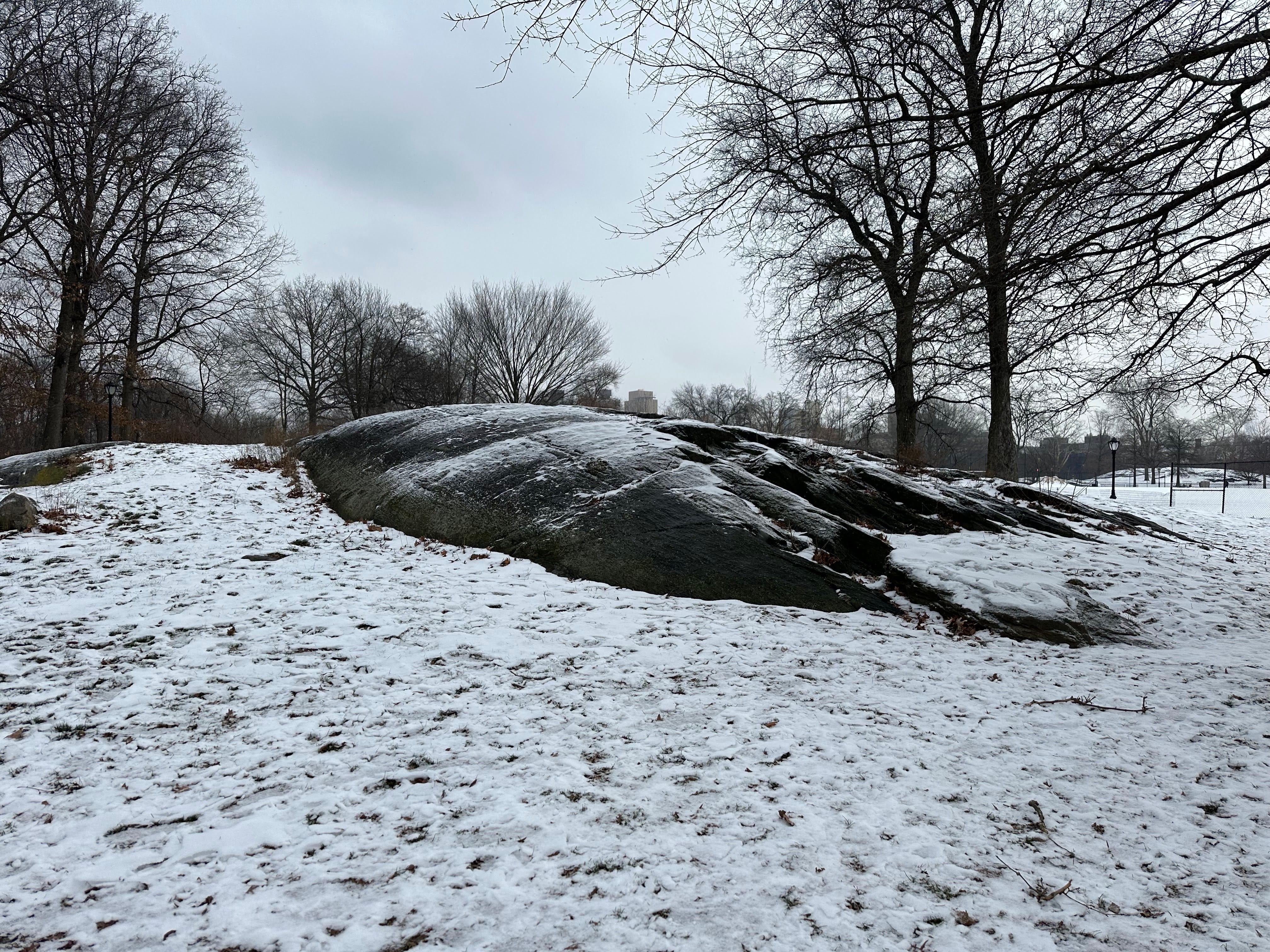
I wondered about the viewpoint of the millennia-old schist rocks in Central Park, which on a gray snowy day earlier this year looked somewhat like surfacing whales.
And I remembered the way in which at a gathering in a library in Queens an old accordion created connections between participants, and stands out in my memory just as much as the human protagonists.
On the role of technology
The session touched on the avenues through which technology - including artificial intelligence in its multiple forms - will and could expand beyond-the-human forms of communication.
Zahra’s piece includes a link to this one: “Making Kin with the Machines”. In it, the authors Jason Edward Lewis, Noelani Arista, Archer Pechawis and Suzanne Kite draw on Hawaiian, Cree, and Lakota cultural knowledges to explore how humans may be able to conceive of AI creations as “kin”, and the implications of doing so. There is so much to absorb that I encourage you to sit one evening and read the full article.
In her section, Suzanne Kite introduces the “agency of stones”, which in Lakota culture “are considered ancestors, stones actively speak, stones speak through and to humans, stones see and know. Most importantly, stones want to help.”
She adds:
“The agency of stones connects directly to the question of AI, as AI is formed from not only code, but from materials of the earth. To remove the concept of AI from its materiality is to sever this connection. Forming a relationship to AI, we form a relationship to the mines and the stones. Relations with AI are therefore relations with exploited resources. If we are able to approach this relationship ethically, we must reconsider the ontological status of each of the parts which contribute to AI, all the way back to the mines from which our technology’s material resources emerge.”
The introductory part of the article includes this, which I read as a powerful appeal/reminder to be cautious of generalities, and to be conscious that engagement and knowledge flows in very specific ways from place(s):
Indigenous epistemologies do not take abstraction or generalization as a natural good or higher order of intellectual engagement. Relationality is rooted in context and the prime context is place. There is a conscious acknowledgement that particular world views arise from particular territories, and the ways in which the push and pull of all the forces at work in that territory determine what is most salient for existing in balance with it. Knowledge gets articulated as that which allows one to walk a good path through the territory.
**********************
Through 2024, It’s Material is sharing one use of the word “material” each week, on Tuesdays.