


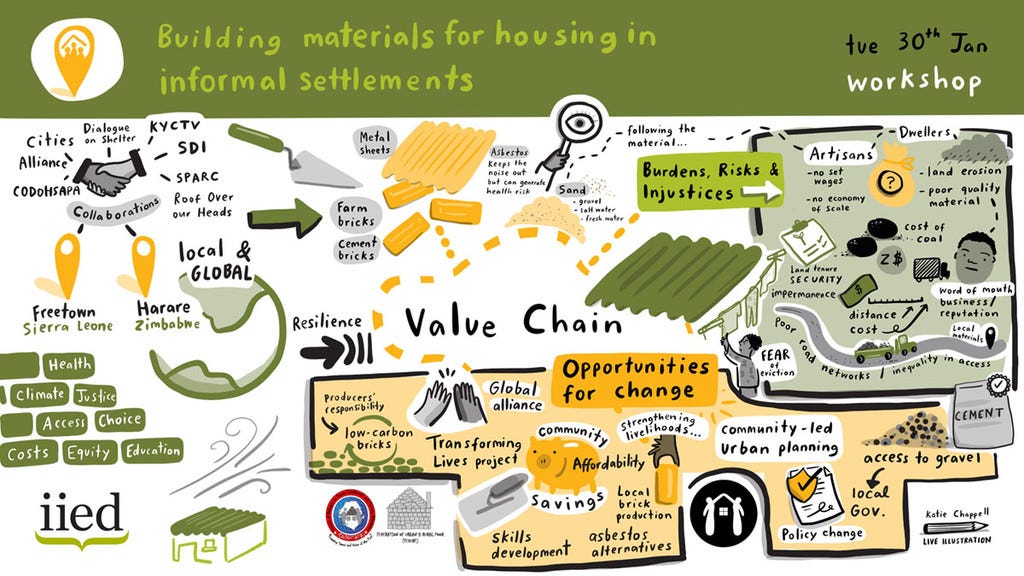
IIED is rocking it with research on housing and resilience, working with local partners. A recent long-read shares the results of research on the supply chains of building materials used by residents of informal settlements in Harare, Zimbabwe, and in Freetown, Sierra Leone.
The research was conducted with two Slum Dwellers International affiliates: Dialogue on Shelter in Harare, and the Centre of Dialogue on Human Settlement and Poverty Alleviation (CODOHSAPA) in Freetown.
As the introduction states:
“Informal settlement dwellers are constantly investing in incrementally improving their housing. Accessing building materials that are affordable and resilient is a key priority for most informal settlement households.”
The piece highlights the juxtaposition between the high levels of profit being made by major companies that extract and distribute materials such as cement in the region - using a production model that has depleted resources and resilience - and locally-sourced and more sustainable materials that have “not received the same levels of incentives, making them less desirable and competitive in local markets.”
In Harare the research focus was roofing sheets and bricks (including “farm” bricks and burnt clay bricks) used in two settlements: Dzivarasekwa Fedland, which is in the process of land tenure regularization, and Tafara Fedland where residents do not yet have legal tenure. In Freetown, the research focused on sand and roofing sheets in the settlements of Colbot and Moyiba.
In each context the research uncovered a complex web of raw material sourcing, manufacturing, and transportation, each of which is associated with formal and informal job creation and labor exploitation dynamics: “drivers, sailors, miners, rock-breakers, vendors, site managers, truck and motorcycle owners, constructors, food suppliers and a long list of occupations feed into the materials’ value chain”. The webs of interactions are unpacked in the article, accompanied by short videos and animations.
The research makes concluding recommendations in four areas:
Livelihoods: Interventions to the building materials value chain “must consider the importance of secure livelihoods, strengthening rather than weakening people’s ability to secure certain living standards”.
Tenure security: Strategies that promote the affordability of sustainable materials “are likely to remain irrelevant for those experiencing uncertain tenure. These challenges must be addressed side by side, acknowledging the complexity of the continuum of land rights.”
Distributions of climate change burdens: The production process for cement is a major contributor to climate change, but concrete (for which cement is a core ingredient) creates more durable homes than other materials used in informal settlements. Hence “interventions in the value chain must consider the cultural dimension of materials and the immediate impact the use of certain materials might have on communities’ resilience and adaptation efforts”.
And governance over technology solutions: The piece concludes with a point that recurs across climate mitigation, adaptation and resilience efforts:
“Ensuring affordable and sustainable materials involves more than developing adequate technological solutions; it is mainly about transforming the governance, incentives, regulations, markets and spaces of decision-making…
Often, successful stories about sustainable building materials in informal settlements are related to the capacity of organised communities to access and store materials in collective ways or to the increased power that collective bargaining brings with providers, builders or authorities.”
Building and construction account for almost half of materials extracted globally each year. Reducing this impact will involve political and economic governance transformations, from the local to the international level.
**********************
Through 2024, It’s Material is sharing one use of the word “material” each week, on Tuesdays.
The IIED research has been added to the “Building Transformation StoryMap”, which is building a global narrative of change in the way that the built environment is imagined, designed, constructed and maintained.