


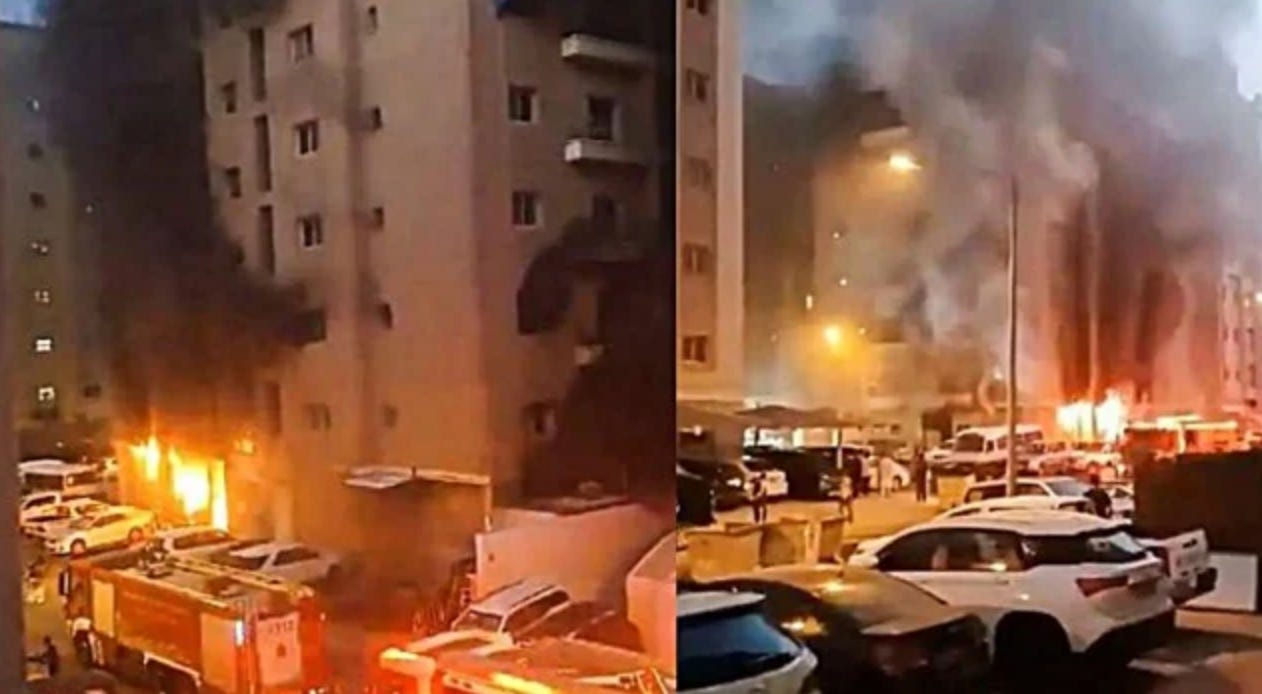
This week the bodies of migrant workers who died in a building fire in Kuwait were returned to Kerala, India. One family member says: “Nobody informed us of anything. No-one from any level of the government. It was via the media that we found out.” The majority of the 49 workers who died were from Southern India; the building also housed nationals of Pakistan, the Philippines, Egypt and Nepal.
This reflects Kuwait’s demographics. Indians represent 21% of Kuwait’s total population of four million, and 30% of its workforce. Development in Indian states such as Kerala hinges closely on the overseas workforce, with workers sending remittances home to their families for daily use and to build homes.
An electrical fault is thought to have caused the fire, while “flammable materials used as partitions [between sleeping areas] contributed to the dense smoke, causing many victims to suffocate while attempting to escape, as the stairs were filled with smoke and the rooftop door was locked.”
Kuwait’s Deputy Prime Minister said "the greed of real estate owners is what leads to these matters”. Arrests have been made, and the government has said it will tackle “overcrowding and neglect”.
In this case the building owner and the employer are the same: the engineering and construction company NBTC group. The group’s managing director - Kuwait-based Malayali businessman KG Abraham - apologized and said the company will be paying compensation.
But these reactive measures won’t shift the structural issues that put migrant workers in construction and other industries at risk: the economic, political and physical structures that mean conditions don’t improve, on worksites and in crowded accommodation.
Back in 2015, Migrant-Rights.org had written that rampant corruption was putting Kuwait’s construction workers at risk. And writing in The Hindu in the wake of this month’s fire, Migrant-Rights.org’s Vani Saraswathi says:
“It is easy to replace a number, recruit anew and bring in more workers to fill the gap left behind by those who perished. To humanise them would mean to acknowledge their presence as more than just labour and entail safeguarding all of the rights of the migrant population, and that would only be possible by dismantling the all-pervasive Kafala system — a complex of laws and practices that ensure state and citizens hold all the power, while individual migrants are treated as temporary even if the dependency on their labour is near-permanent…”
Migrant workers across Gulf Cooperation Council (GCC) countries face restrictions on the right to unionize and to strike, and continuing indebtedness through recruitment fees despite laws requiring employers to cover those costs.
The incident has re-ignited calls for a review of corruption relating to recruitment practices, and also relating to housing violations. Corruption and corner-cutting in construction that puts lives at risk - predominantly the lives of migrant and low-income residents - is by no means limited to the Gulf region: think of the Grenfell fire in London, seven years ago this month, the fire at 80 Albert Street in Johannesburg last August.
A global anti-corruption conference is underway in Vilnius this week, bringing together “heads of state, civil society, business leaders and investigative journalists from around the world”. The more that the conversations and solutions are grounded in the tangible experiences of corruption in the lives of workers and their families, the better.
*******************
Through 2024, It’s Material is sharing one use of the word “material” each week, on Tuesdays.
Related:
“Among Kuwait fire victims from Kerala, an engineer who joined just days ago, another who sent his first salary home last week”, Indian Express
A piece I wrote following the 2023 Turkey-Syria earthquake, in which pay-offs to avoid adherence to building codes meant the loss of life was much higher than it could have been: “Irresponsible construction comes with a human and environmental cost”