


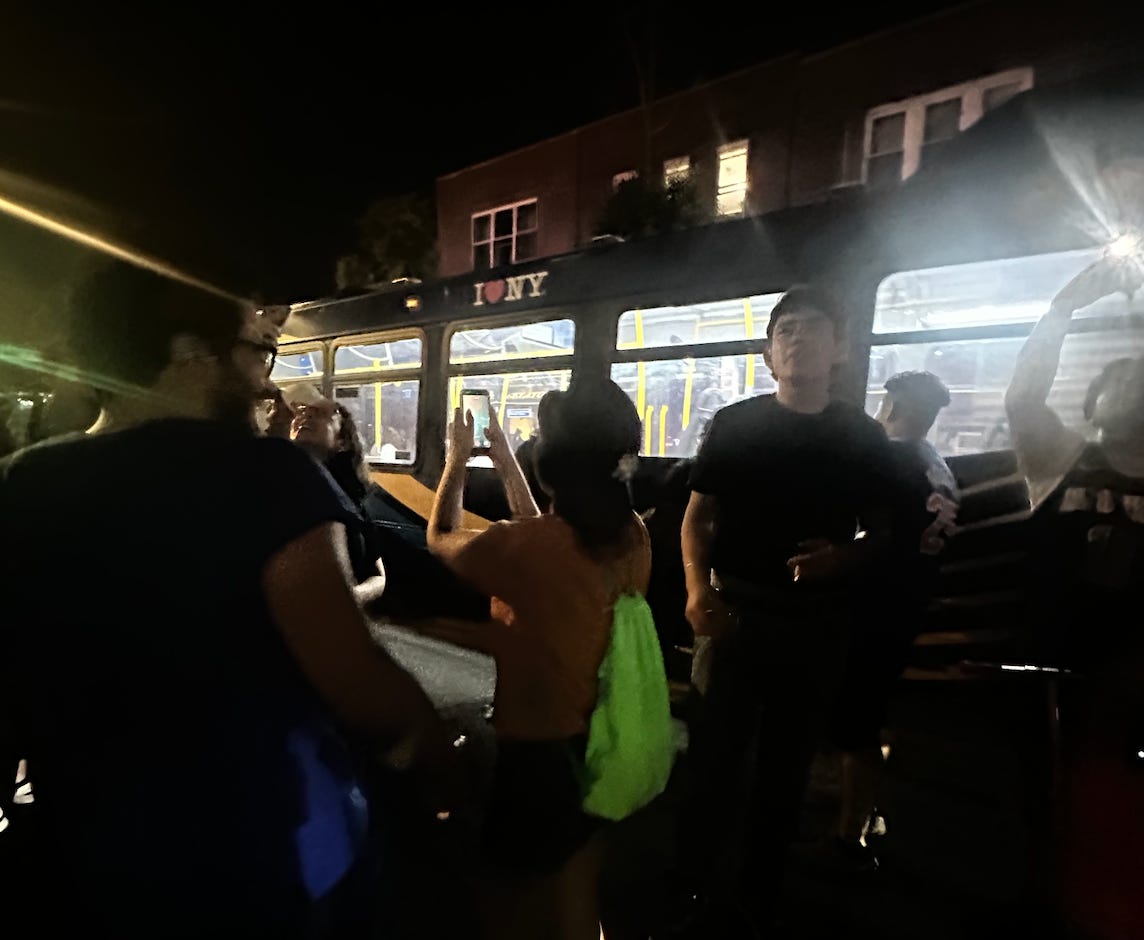
On Saturday night my husband and I spent about an hour going around our Queens neighborhood of Astoria looking for a spot to watch the Knicks in what was potentially their victory game of the series - a chance to win the NBA championship for the first time since 1973.
Between Morocco and Brazil fans engrossed in the World Cup football match underway and Knicks fans who had planned better than us, everywhere was already packed. We eventually found a spot in Acento, a small Latin restaurant and bar in the Ditmars part of Astoria, just as Brazil v. Morocco ended with a 1-1 draw.
Meanwhile my two teenage boys started watching the game at a friend’s place in Manhattan, then moved at half-time to a pop-up watch party in a nearby street where a hardware store hung up a screen from its awning.
Multiply those scenes by hundreds of thousands.
Across New York’s five boroughs, people were huddled together engrossed in the same game, all spilling onto the streets in jubilation when the Knicks won. As many have pointed out New York, this brimming, sprawling, complex city of millions, felt like a small town. Other stand-out moments of unity have been in tragedy: 9/11, superstorm Sandy. This moment of deep connection, while like those ones full of love, was for a change also full of pure joy.
Now with the basketball season over (though not yet the victory parade, which will be this Thursday), football is filling the gap. Supporters of the 48 competing teams are out in the city’s streets, from Bosnia to Haiti, Ecuador to Australia.
Like every World Cup - always an amplifier of the power dynamics of the day - this one has been full of controversy. Perhaps more than ever there have also been dynamics of exclusion, with tickets at extortionate prices few can afford, and with US immigration restrictions meaning that fans of some competing teams can’t make the games in person even if they can afford it, that a Somali FIFA referee was turned away at the border, and that players and their entourages have faced visa delays. The Iranian team has had to locate its base camp in Mexico and fly back and forth for its matches in the US.
A colleague in Mexico City summed up the sentiment just before the opening match there. The palpable excitement for the sport, she said, was accompanied by the sound of helicopters whirring over the city from the early morning as they controlled protests by the families of people who have disappeared.
How do you hold both sentiments in mind at the same time? How do you embrace the escapism of sports when there’s so much to be fighting against?
It’s hard but it’s possible. Actually essential. From the outside, there’s a simple pervasive narrative that the US, in particular, should not be hosting the World Cup this time around. Yes of course Trump will make every effort to co-opt the tournament - and the sport more broadly - to his advantage. From the inside, though, it feels like it’s a key moment for the US to be hosting.
Now more than ever we need a global spotlight on what’s going on in the country. And now more than ever we need moments that spark encounters and connections between people who wouldn’t usually connect with each other. From those connections, different narratives, different emotions emerge, countering and crowding out the dominant and oppressive ones.
Like the Knicks and Spurs games, most of these moments won’t happen in stadiums. They happen in streets, in parks, on transit, in homes, schools, and workplaces. They’ll be documented and digitized and shared, and some of them commodified, but underneath all that are real beating hearts, real minds making memories while fully embracing the present and each other.
*******
Since 2024 I’ve been working on a youth media initiative with teenagers in four of the World Cup host cities: Guadalajara, Toronto, New York New Jersey and Los Angeles. Check out their stories for thoughtful takes on the tournament, and more widely on the role of sports in their lives.
Also check out World Cup Memory - and add yours if you have one: good, bad, or in-between!
Love this! So spot on. Thank you!