


What gets built - and what gets demolished - always holds a bigger story. And some of those stories get told more than others.
A story that’s touched a nerve across the internet this week is Trump’s demolition of the East Wing of the White House to make way for his new ballroom. It will - probably - be white on the outside but with a lot of gold on the inside, and is financed by donations from the likes of Amazon, Apple, Palantir Technologies, and Blackstone’s Stephen Schwarzman.
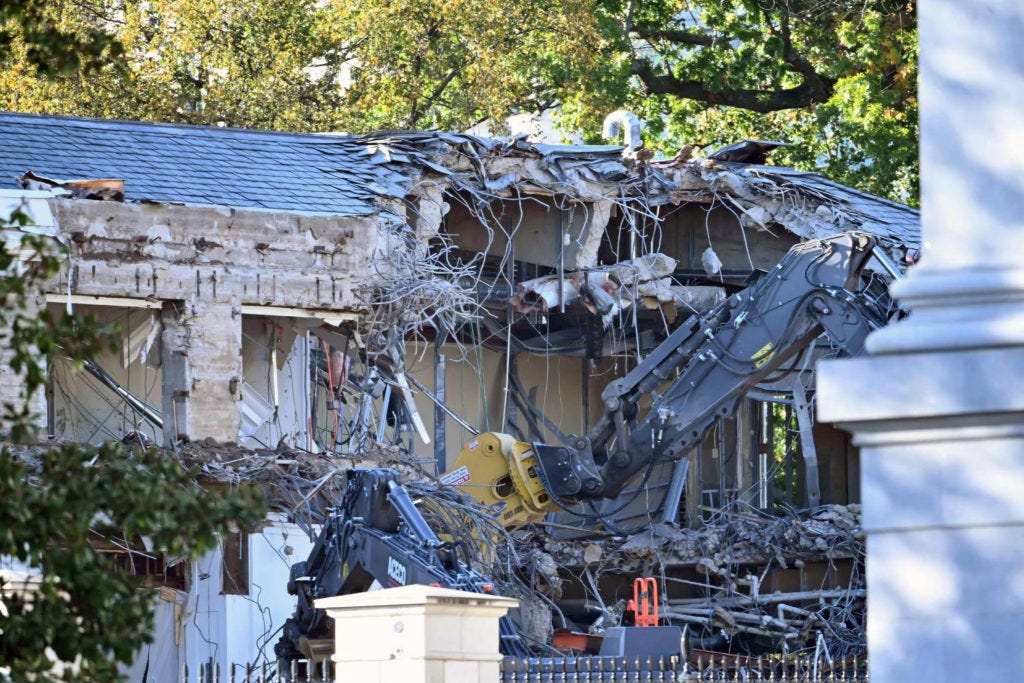
In this world of bifurcated digital feeds, mine has been full of analogies between the demolition and the Presidency as a whole - a wrecking ball being brought to democracy, the destructive will of one man’s ego laying waste to the country’s past. Other feeds are no doubt celebrating the boldness of the change.
The move follows a long tradition of what could be described as authoritarian monumentalism, as power-hungry leaders seek to project that power into building - from statues, to ballrooms, to whole cities.
Meanwhile in Europe, the investigative newsroom CORRECTIV has been shining a light on a more everyday form of demolition.
Buildings - their materials, construction processes and energy use - contribute 36% of Europe’s CO2 emissions. The EU has a bold plan to renovate 35 million buildings to improve energy efficiency by 2030 - but at the same time isn’t tracking buildings that get demolished and replaced by new ones, which the non-profit campaign HouseEurope! has put at a rate of around one every minute.
As the CORRECTIV article points out, when existing housing is demolished and rebuilt, it’s often people with low incomes who lose their homes. It’s a reflection, once again, of misaligned economic incentives, that in a region where access to affordable housing is a major challenge and construction and demolition waste makes up a third of the waste stream there’s still a pervasive cycle of demolishing and building new.
There are signs of a narrative and cultural shift underway though. And with them, the economic shifts may follow (including a more diversified market). Prestigious architectural awards are going to designers who transform existing buildings and ensure affordability - a few years ago the Pritzker was awarded to Anne Lacaton and Jean-Philippe Vassal whose manifesto calls for architecture to “never demolish, never remove - always add, transform and reuse.”
“Demolition is a form of violence,” Lacaton has said.
The Financial Times architecture critic Edwin Heathcote recently wrote a piece called Adapt or die. “Architecture’s dark, dusty side is a shadow world in which buildings are demolished to make way for the new”, he opens. And goes on to describe inspiration and momentum in countries like Germany, Belgium, and the UK, where the Tate Modern’s “turbine hall” is an iconic example and where a “Don’t waste buildings” campaign is underway.
Reuse is not yet the norm, Heathcote concludes, but “if we are more exposed to the benefits…to the value of urban memory and the sheer mad waste of crunching up all that debris, we might begin to see the potential and the beauty in what already exists.” Something that my New York project, “51 to 1 - Building NYC” seeks to do in a small way.
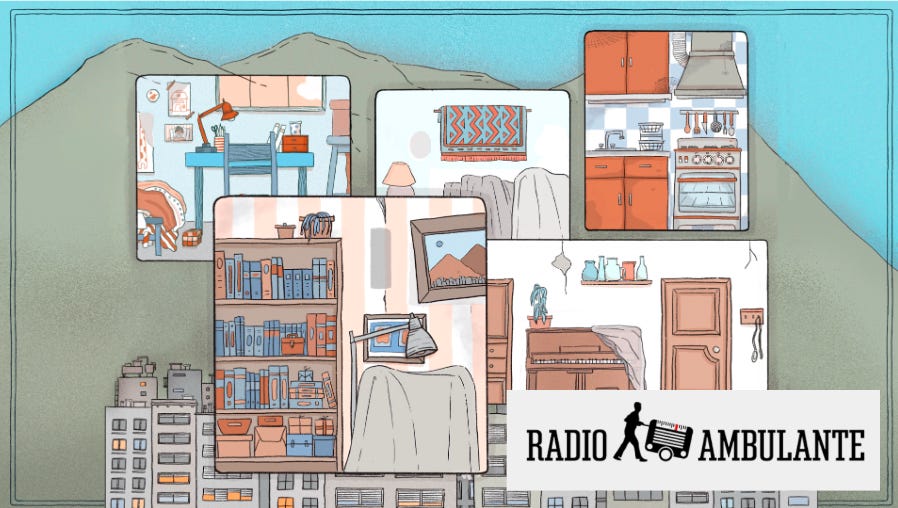
A gorgeous example of the kind of built environment storytelling that we need so much more of is Radio Ambulante’s recent podcast, “Inventario del exodo”. You can listen in Spanish and access the Spanish transcript here, and the English transcript is here.
In Venezuela, the fact that almost eight million residents (nearly a quarter of the population) have emigrated in recent years has left over a million empty homes, usually still containing the furniture and belongings of their former inhabitants.
The podcast narrates the story of people who at some point need to decide what they are going to do with all those belongings, in absentia. We also hear from Mayrin, who has created a new profession for herself helping overseas residents do just that, stirring up all kinds of emotions along the way.
Soledad, a lawyer who now lives with her daughter in Chile, says:
“No es lo que valen esos objetos en dinero. Las memorias que están indisolublemente asociadas. Una silla no es solo una silla. Una silla es donde te sentaste a amamantar a tu hija.”
“It’s not what the objects are worth in money. It’s the memories that are embedded in them. A chair is not just a chair. A chair is where you sat to breastfeed your daughter.”
The stories have a profound sadness about them. They are also beautiful stories of care, built up over time. And if you keep listening (or reading) there is a story of hope - of things coming full cycle - at the end.
Interesting and valid take. I suppose there would have to be some cases where buildings need to be demolished but they could certainly be minimized. A lot of waste gets created in the current process.